Chemical Weather Observations of Carbon Chemistry in Greater Bay Area
2026 – PresentResearch Grants Council — Theme-based Research Scheme, HKUST
Roles: analytical method development, data analysis
Understanding the chemical compositions and sources of air pollution to inform policy, protect public health, and advance atmospheric science.
My research applies field measurements, laboratory experiments, and data analytics to study the connections between emissions, air quality, and health effects. My vision is, through my research, to provide the scientific basis needed to inform policy development that can, in the near term, alleviate the health burdens of air pollution amid the challenges of urbanization and aging societies, and in the long term, empower societal resilience under the pressure of changing climate and steer societies toward sustainable development.
The air pollution we are exposed to comprises a complex mixture of chemicals released from numerous anthropogenic sources. A large part of my research has been focusing on traffic-related air pollution, especially on quantifying their source contributions. Existing methods for quantifying the contributions of traffic emissions are accompanied by different inherent methodological limits. One prominent example is that the atmospheric oxidation reactions of molecular source markers and semi-volatile nature of many organic aerosol components (i.e., organics that constantly transfer between gas and particle phase in the atmosphere) can introduce substantial errors in quantifying the contributions to ambient particulate matter (PM). In my dissertation I developed new approaches to incorporate these dynamic atmospheric processes into receptor model-based source apportionment, demonstrating a new pathway to improve source quantification.
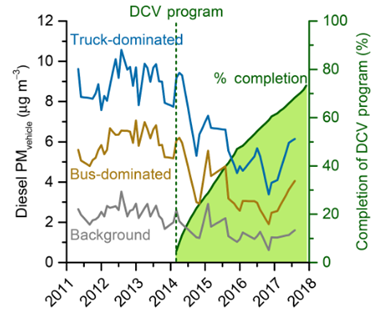
Roadside air quality monitoring has long been used by regulatory agencies to assess the impact of traffic emissions on air quality and population exposures. However, existing methods for quantifying traffic contributions are often oversimplified (e.g., by comparing concentrations of targeted pollutants between roadside and background sites), which do not provide information on the impacts associated with individual vehicle categories. By integrating the particle-phase organic and elemental carbon and speciated volatile organic compounds (VOCs) measurements in receptor modeling, I resolved the PM and VOCs contributions attributed to vehicles running on diesel, gasoline, and LPG. The results provided evidence in support of the effectiveness of various vehicle control policies implemented by the Hong Kong government, and offered a practical means for long-term monitoring of the evolving traffic emissions.
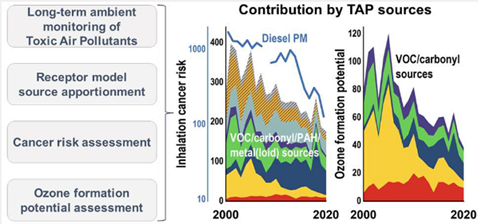
Diesel exhaust, PM-bound metals, along with many VOC species are classified as toxic air pollutants known or suspected to cause cancer and various adverse health effects. In my postdoctoral research I examined the long-term trends for a list of toxic air pollutant species in Hong Kong. Coupling the monitoring data with dose-response relationships, I identified that the major sources contributing to inhalation cancer risks have shifted remarkably over the past two decades. Specifically, the health benefits gained from controlling traditional fossil fuel combustion-related sources were partially offset by emerging regional industrial VOC sources. The work provides the scientific basis to steer air quality management from traditional pollutant-concentration-based assessment toward health-risk-based decision making that is better oriented at protecting public health.
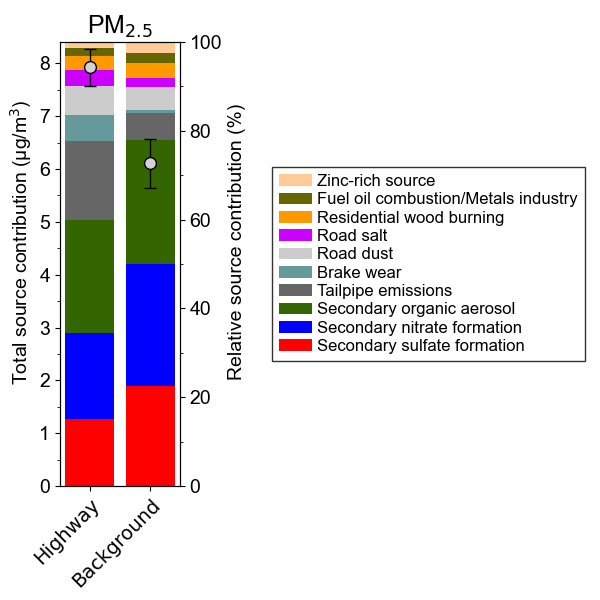
The increasing significance of non-exhaust PM emissions from brakes, tires, and road dust due to reductions in tailpipe emissions has drawn global attention. To better understand their environmental and health impacts, my postdoctoral research at University of Toronto integrated field measurements and statistical modeling to examine their physical and chemical characteristics and their spatiotemporal patterns in urban environments. By coupling detailed PM chemical speciation measurements, high time-resolution CO2 monitoring and traffic data, I was able to retrieve the emission factors for non-exhaust emissions at near-road environments that have much more complex vehicle fleets and driving conditions than what laboratory experiments can simulate, providing valuable data to constrain model estimates.
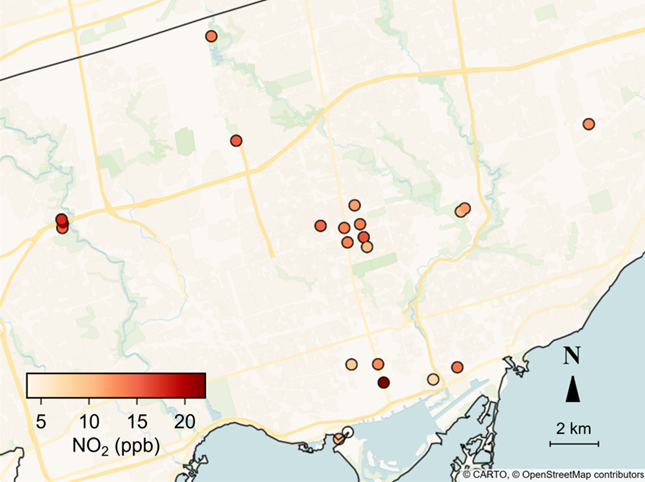
Alongside using sophisticated measurement techniques, I also evaluated and applied low-cost sensor (LCS)-based air quality monitors, developed in collaboration with an industrial partner, to enhance the characterization of air pollution sources and exposures in Canada. A bottleneck of using LCS to achieve various monitoring purposes is that the responses of LCS are heavily influenced by the environmental conditions in the field. To address this, I developed various data correction strategies including machine learning-based methods to improve the accuracy of the PM2.5, NO2, O3, NO, CO, and CO2 sensors equipped within the monitors. The methods enabled us to retrieve the signals and spatiotemporal patterns of traffic-related emissions from a sensor network consisting of more than 20 locations across Toronto, demonstrating the merits of such sensor technologies in resolving fine-scale exposure patterns, which could not otherwise be achieved based on sparsely distributed regulatory monitoring stations.
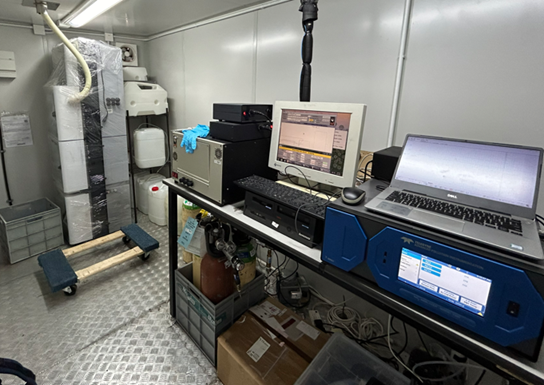
Although the air quality in China has improved significantly, air pollution remains an important public health concern. In particular, the rising contributions of O3 and secondary organic aerosol (SOA) despite stringent source controls over the past two decades present a significant challenge to the Greater Bay Area. Currently at HKUST, in connection with a Theme-based Research Scheme project funded by Research Grants Council, my research expands to developing new analytical techniques for atmospheric applications. One of them is an instrument that measures the total reactive organic carbon in the gas phase, which is also known as the "fuel" in atmospheric oxidation chemistry that drives secondary pollutant formation. This instrument will provide critical field measurement data to constrain both O3 and SOA modeling. Another related instrument I am currently developing is an online aerosol carbon and nitrogen analyzer that can simultaneously measure organic and elemental carbon and organic and inorganic nitrogen contents in atmospheric aerosols. This monitoring capability will advance our understanding of the environmental impacts of the increasingly important nitrogenous aerosols as carbonaceous aerosols continue to decrease across China due to reductions in anthropogenic emissions.
Research Grants Council — Theme-based Research Scheme, HKUST
Roles: analytical method development, data analysis
U.S. Health Effects Institute, University of Toronto
Roles: investigation, formal analysis. Research report under review by HEI.
Environment and Climate Change Canada, University of Toronto
Roles: investigation, formal analysis
Hong Kong Environmental Protection Department, HKUST
Roles: investigation, formal analysis
Hong Kong Environmental Protection Department, HKUST
Roles: project administration, investigation, formal analysis
Hong Kong Environmental Protection Department, HKUST
Roles: project administration, investigation, formal analysis
Hong Kong Environmental Protection Department, HKUST
Roles: project administration, investigation, formal analysis
City of Toronto, University of Toronto
Roles: data curation
Wong, Y. K., et al. "Study of traffic-related air pollution using a low-cost sensor network in Toronto, Canada" (2025). European Aerosol Conference, Lecce, Italy (Platform)
Wong, Y. K., et al. "Contributions of non-tailpipe emissions to ambient particulate matter near a major highway in Toronto, Canada" (2025). European Aerosol Conference, Lecce, Italy (Platform)
Wong, Y. K., et al. "Evaluating the intra-city variability of traffic-related air pollutants in Toronto using complementary field measurement approaches" (2024). International Society of Exposure Science Annual Meeting, Montreal, Canada (Platform)
Wong, Y. K., Huang, X. H. H., & Yu, J. Z. "Tracking vehicular emission contributions to roadside PM2.5 through online monitoring of volatile organic compounds, PM2.5 organic and elemental carbon: a six-year study in Hong Kong" (2019). European Aerosol Conference, Gothenburg, Sweden (Platform)
Wong, Y. K. & Yu, J. Z. "Impact of diesel container truck emissions on carbonaceous aerosols in a unique roadside environment in Hong Kong" (2018). 10th International Aerosol Conference, Missouri, United States (Platform)
Wong, Y. K. & Yu, J. Z. "Hourly measurement of carbonaceous aerosols in a roadside environment in Hong Kong" (2017). 5th International Symposium on Regional Air Quality Management in Rapidly Developing Economic Regions, Guangzhou, China (Poster)
Wong, Y. K., Huang, X. H. H., & Yu, J. Z. "Hopane degradation: new observational evidence and their incorporation into chemical mass balance source apportionment of PM2.5" (2017). General Assembly of European Geoscience Union, Vienna, Austria (Poster)